About Wenceslas
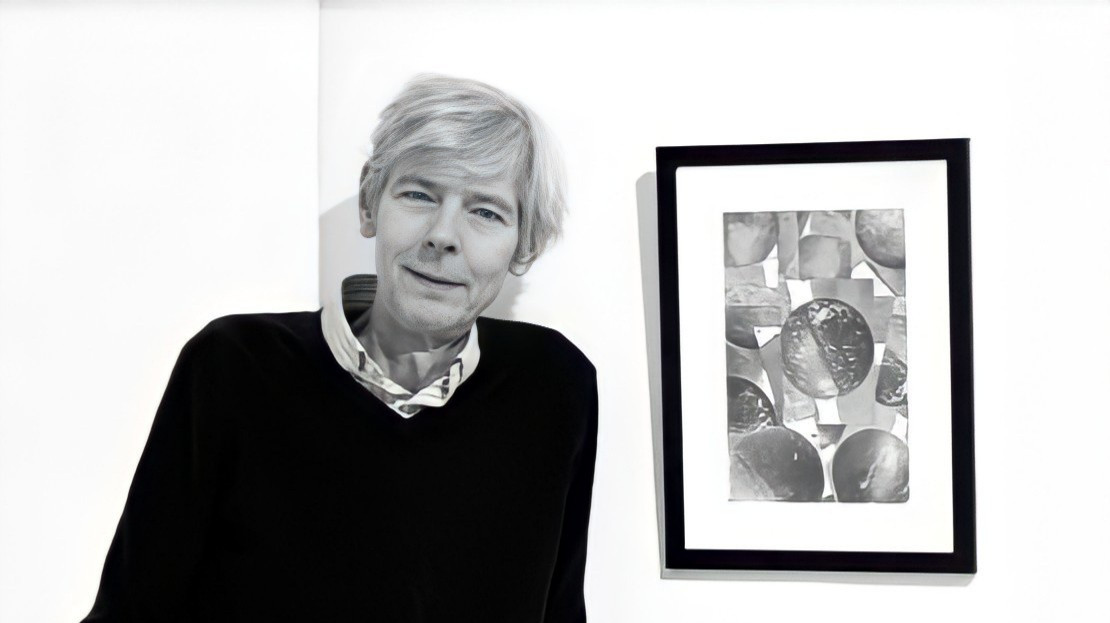
About Wenceslas
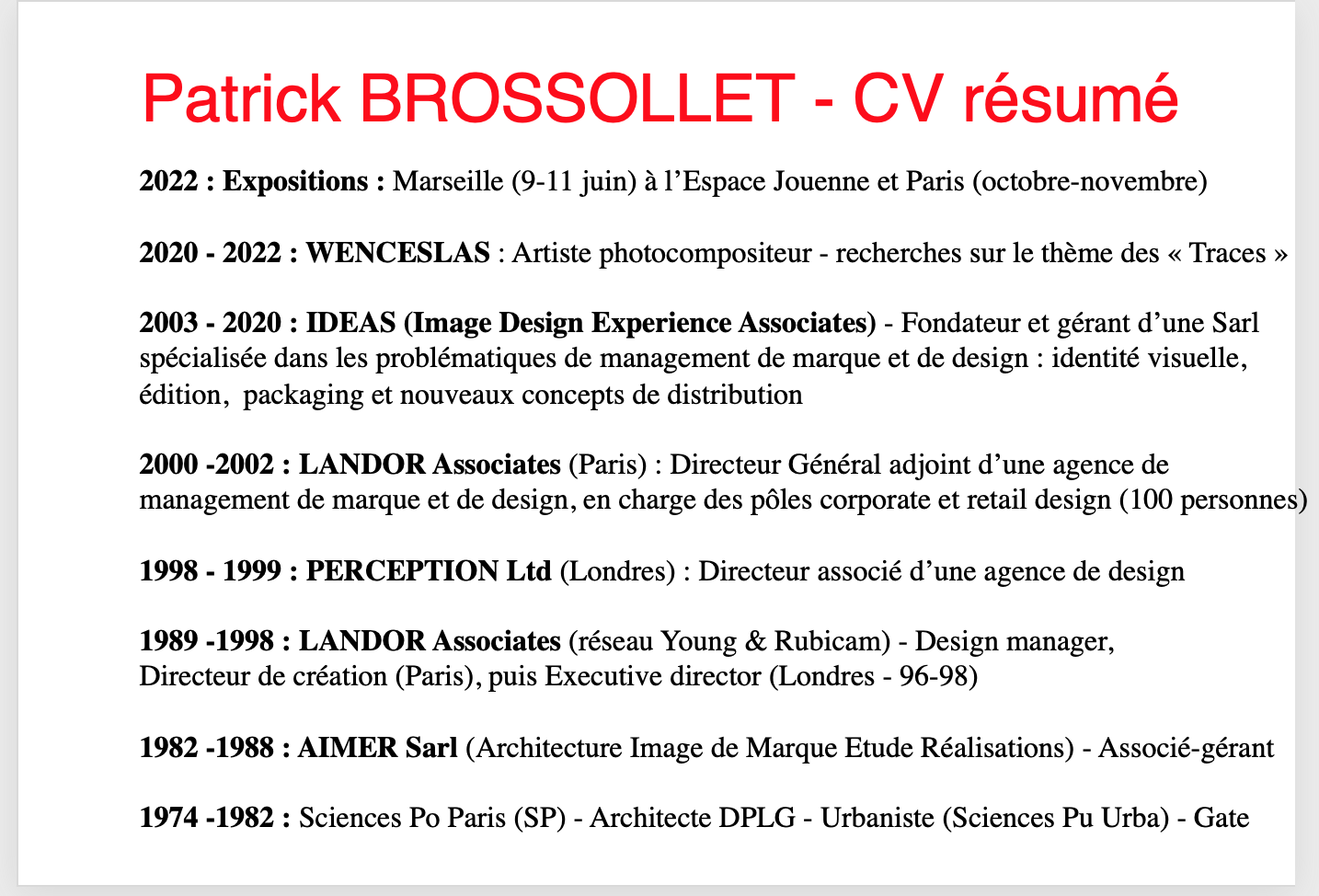
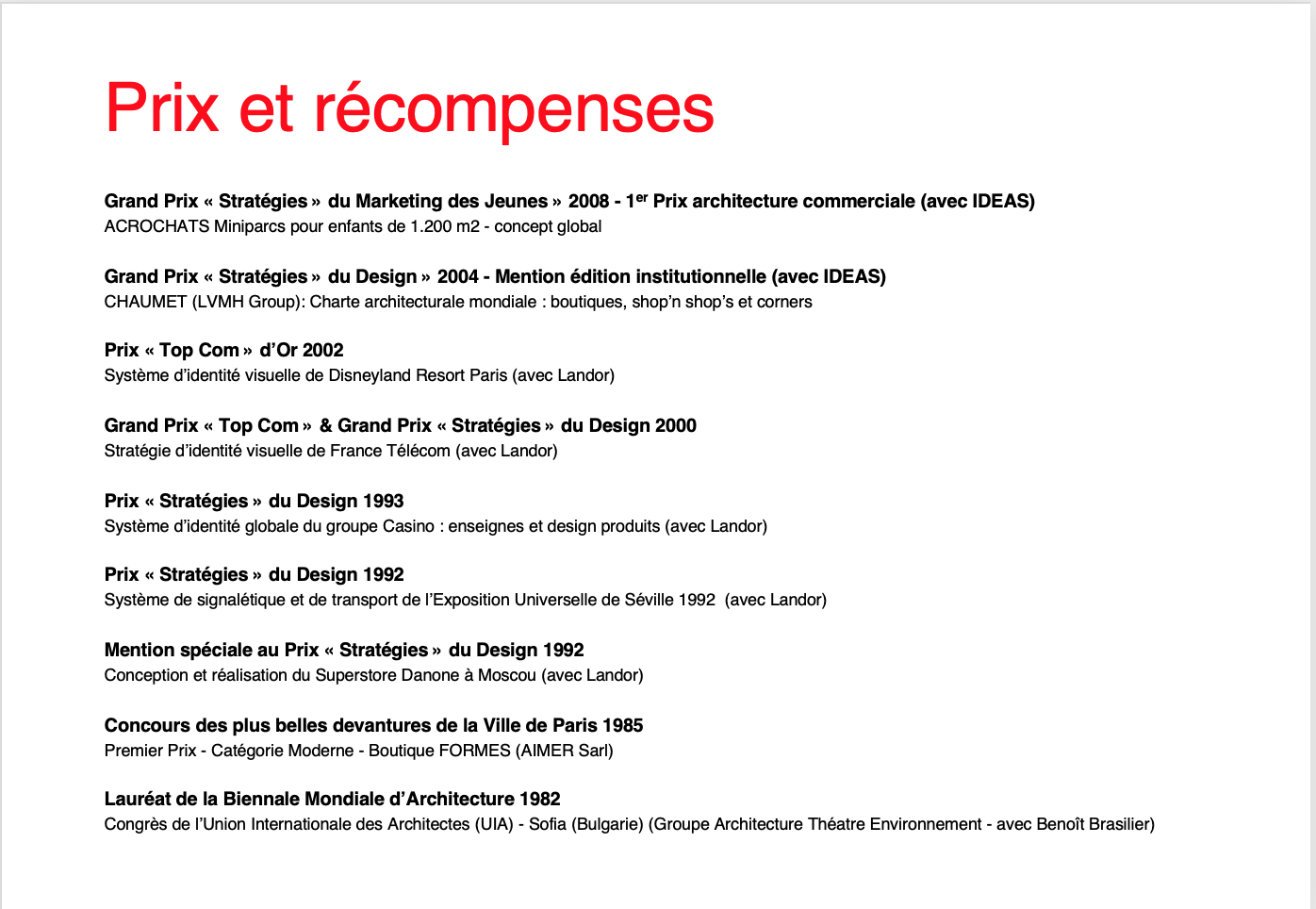
MATTER OF DREAMS
Marc Lambron, of the Académie française - Preface of the Marseille Exhibition - June 2022
At the dawn of photography, pioneers elevated the city into an aesthetic object, such as Marville, Atget, later Berenice Abbott. Their records of aspects amounted to a poetic rendering of urban fragments.
This gave rise to a certain relationship to landscape, to site, to object.
Every heritage provokes mutations. By sampling forms, adding chance to perception, instilling propulsion into the immobile, Wenceslas’s photocompositions situate, at pedestrian level, an electric hymn to the city. The artist wandered through the streets of Marseille and Paris as one chooses a biotope of imagination.
The eye paused on propositions, the randomness of the walk fertilised connections.
Wenceslas arranges fragments of reality. He photographs materials, textures, surfaces, then recombines them according to a principle of guided chance. It partakes of mimesis and assemblage. The combinatory respects the source figure but projects it towards unexpected possibilities.
These samples nourish expansions, these hybridisations systematise the diversion of artefacts. Manhole covers bloom into an arsenal of shields, metallic hubs are treated like Toltec mandalas. Logic of industrial music: it seems like the capture of frozen kinetic forms, like concretions of speaking metals.
The absence of human silhouette condenses reality here according to the project of an invisible demiurge-eye. The aggregate signs its presence. Under the digital lens, matter exudes dream. Smudges, flat tints, scrapings, wear, the objectivity of things turns into a quasi-psychedelic experience, with its rotations, its flows, its pigmentations. Wenceslas does not alter the colours:
the palette lies within the objects, the chromaticism results from their composition.
In azure zones, his gradations reveal the blue of the ground. In seaside zones, the mauve of the beaches.
But they also exalt a virtuality of metamorphoses, offering to the gaze arrested aeroliths, auriferous veins, coral bushes, stellar punctuations... Barely is asylum granted, by exception, to fragmented human myths, cut, broken into kaleidoscopic tributes: the late Prince Philip of Edinburgh, David Bowie in his Ziggy era. As if Marseille and Paris, world-cities, were conversing across the Channel with another metropolis of mixtures.
Each viewer may project their own reminiscences onto Wenceslas’s compositions, so full are they of seminal power. Collages of Moholy-Nagy, poems of Henri Michaux, music of Varèse?
Yet the evocations cannot exhaust the intrinsic. Wenceslas is an artist of the signature-gaze. This Bohemian of Marseille and Paris has invented an elegy to the cities. This sorcerer of mixtures infuses into our psyches a matter of dreams.
THE PAVEMENTS OF MARSEILLE
Wenceslas - Catalogue of the Marseille Exhibition - June 2022
I cast off from the Old Port in 1983 to sail towards Istanbul, where my Czech grandmother lived in a yali on the Bosphorus. Marseille was therefore, for me, a point of departure nearly 40 years ago.
French through my father, Prague-born through my mother, I have always felt half Parisian, half Bohemian.
Two years ago, at the dawn of Covid, Marseille called me back thanks to the fine intuition of my wife Laurence, who had sensed that this city would become our ideal home port for a new beginning.
I therefore adopted Marseille in 2020 as my new capital of the heart. We now live there, a few cable lengths from the Old Port, the point of confluence of my daily walks.
It is the city where my present and future are now being written.
By wandering each day through its streets, I absorbed its incomparable light.
These “urban wanderings”, dear to the Situationists, carried out at a slow pace, iPhone in hand, eyes attentively fixed on the ground before me, recalled those 1970s when I composed my first photographic collages: “On the Rooftops of Paris” and “Cardboard Undulations”.
Throughout my strolls, my gaze settled on elements, seemingly insignificant, that inhabit the pavements of Marseille: manhole covers, protective bollards or kerbstones, fire or gas hydrants, building doors, ventilation grilles, pedestrian crossings, balcony shadows, or others, more noble, such as fountains, statues or ornaments of urban architecture.
These “traces” offered me raw material full of hidden poetry; they were like potential vectors of abstract landscapes to be created.
When one of these traces suddenly imprints itself on my retina and impresses me with its hidden meaning revealed to me, I lean forward, bend down, lens straight, to capture it “photo-graphically” as a snapshot of my steps. I immediately record this fragment of reality in my smartphone to render it memorable and transcribe it into my works, once revealed on paper.
These “traces” of the pavements of Marseille, marked by the wear of their use, are the basis of my photocompositions and give their title to this exhibition.
Each of them is, at once, a tribute to Marseille, this city that welcomes me with energy and warmth, a salute to the passing of time and a memory of the traces that everyone leaves there, myself too… with great joy.
SINGULAR AND PLURAL
www.lautremag.news - Catalogue of the Marseille Exhibition - June 2022
Tall, slender silhouette, the cerulean gaze like the sky unsettled by the mistral, half-rebel, half-dreamer, yet always ready to seize singularity, the occurrence that magnifies a banal moment into a snapshot riddled with the unusual and with phantasmagoria, such is Wenceslas, modern pilgrim of our world-cities.
This Bohemian, proud of the Czech origins of his mother, tasted from childhood the marvels of the great European and Mediterranean cities, cradles of Fine Arts and of our civilisation: Paris, Rome, Athens, Istanbul, Prague, Madrid.
The iridescent hues of the Bosphorus, of Prague’s Vltava or the Tiber, and the museum strolls of his childhood with his father in the marvelling discovery of the great masters so irrigated young Wenceslas that within him, secretly, an artistic fibre grew strong. They crystallised his vocation as architect-urbanist, then designer. His long professional practice refined his sense of detail, as much as it sharpened his predilection for hidden geometries.
A lover of Cézanne, Matisse, Kandinsky, Dalí, Klee, Hantaï, Arman, Warhol or Rothko, it is often with one of them in mind that he uncovers the material that will become the theme of his “photocompositions”.
Explorer of the strange, he tracks the passage of time. From these heterogeneous urban objects, his photographic lens reveals their wear, truncates them, conceals them or, on the contrary, celebrates their use — fragments recomposed from our shared history.
“Wear is the revealed beauty of ageing things,” says Wenceslas.
Then comes the time to gather, to attune, to unite or to disunite these hundreds of fragmentary traces into a photocomposition, a kaleidoscope that will reveal the hidden meaning, the artistic sensitivity that seized them. At the heart of the procedural stages, the birth act of each work, lies the artist’s privileged moment: a patient work of tuning. This may be elaborated in a few hours or take months of reflection, trials, revisions. This weaving of photographic elements is his intimate garden. For the man is secretive, reveals little, and delivers himself only through his art.
Architect of unreality, yet drawn from the utilities of everyday life, Wenceslas pays fine tribute to the anonymous and graphic labour of these objects, as well as to the shared uses of the urban fabric, invisible, that binds us to one another.
There lies the paradox, there, above all, lies the poetry.
LOCKDOWN – UNLOCKING
Wenceslas - Catalogue of the Lectoure Exhibition - May 2023
It was on 16 March 2020, the eve of Saint Patrick’s Day, that we definitively left Paris to “lock down”, following Emmanuel Macron’s orders, for several months, without really knowing, at the time of departure, the duration of this sudden rupture in our lives.
We quite naturally and fortunately chose as our destination “La Bartavelle”, our family home in Eygalières, and set off there on the 5.30pm TGV.
This lockdown was for me, as for others who had the same good fortune to find a haven of peace to escape this distressing pandemic, whose outcome no one could foresee, the exceptional occasion of a true mental and artistic, and I would say spiritual, unlocking.
I experienced those unforeseen and unprecedented moments as a kind of initiation into living each instant in its duration, spending time contemplating the Alpilles and discerning, each day, the transformations taking place there in Spring: the lavandins stretching and raising their stems towards the sun, the lagerstroemias bursting their buds at winter’s end, the incomparable light that makes the sunsets of Provence so different and each one so unique.
In that long, almost suspended time, on the lookout for news of the fatal wave, the desire returned to me to capture moments with my iPhone and to collect fragments of instants, until forming collections of images.
These images I reassembled to imagine workable series, then joined them one by one so that together they might take on full meaning, then cut them. I then arranged and framed all these fragments of images and finally glued them, as if welded to one another, to give birth in my photocompositions to unique original works, in the spirit of my first creations in 1975. That will soon be 45 years ago.
I now continue, with patience and passion, my work to capture the “traces” we each leave, together with the nature that connects us all, and to bear witness through my works.
THE ALCHEMIST’S GAZE
Alain Vircondelet - Preface of the Lectoure Exhibition - May 2023
It is a gaze, a prism, a beam of light upon the erasable and the engraved, upon the ephemeral and the eternal, upon the transitory and the immutable, upon the trace and the fugitive.
A gaze that roams and that captures, a gaze that also wanders, solitary, and that has seen, for a long time: star dust, flashes of lightning, fractures and wounds. A gaze necessarily in quest, that searches and knows full well the risk of finding. What? What secret? What mystery? Images torn from their static pain of cast iron or wood, from Bowie’s heterochromatic eyes, from the acid flashes of pop bad trips, from the impenetrable movements of sands, always shifting, from all that escapes and of which no one is master.
The gaze continues its path, it falters but, tenacious, resumes it. The images, like series, deceive, unrecognisable, gone towards unlimited destinations, towards unknown realms, and yet it is indeed what remains of our walks. Like the shifting dunes of deserts, endlessly shaped by winds indifferent to the desire for eternity, the traces of walking fade and blur.
The pilgrim’s gaze of Wenceslas marks the passage. He does not freeze it, on the contrary, he restores to it source and life, fever and blood, he irrigates and animates it. To animate is to restore presence to the soul, to the spirit that infuses the Living. Thus do Wenceslas’s works address us. What we thought already seen, already encountered, becomes totally new, fresh, kinds of mantras that their author might have repeated endlessly. The images seized in their everydayness, often trivialised to the point of becoming unreadable to our eyes, in their learned gathering, that which Wenceslas arranges, then provoke vertigo. It is at that precise instant of the adjustment of clichés that, if one believes Umberto Eco, in his famous book on the vertigo of lists, Wenceslas, like Joyce, Borges, Perec, as well as Klee, Peter Blake, Warhol or Robert Rauschenberg, transforms his inventory into a “poetic list”. It is the full meaning of Rimbaud’s words in this invented language presented here: “To write silences, nights, to note the inexpressible, to fix vertigo.” Wenceslas thus shows what was not in reality “finished”. The possibilities of expansion of which he bears witness make our gaze falter, and all that theological sums, encyclopaedias attempted to fix in their vain repertoires is here pulverised, shattered into an effervescent mixture that reshapes, in a certain way the world, renews the secret relations that govern it, and comes to establish other hierarchies, to inspire other exchanges, plural and unknown, finally to delight, through its eruptive force, our own gaze up to wonder.
WENCESLAS
Cyrille Putman - Preface of the exhibition in Arles - June 2023
Wenceslas is a curious case writ large.
A jack of all trades, he builds a body of work off the beaten track.
His accumulative collages embrace a vision of this world that spins faster than the music.
This intimate, delightful and refined work takes us on his mental journey, where time has stopped.
Let yourself be carried away by the work of Wenceslas, an atypical figure.
You will discover his perception of passing time, without losing your own.
CROSSED PERSPECTIVES: PREFACE TO THE PARIS EXHIBITION - HÔTEL DE L'INDUSTRIE - OCTOBER-NOVEMBER 2024
Alain Vircondelet - July 2024
“Dear Marc Lambron, we had already each written the preface to Wenceslas's first two exhibitions (one in Marseille in June 2022, the other in Lectoure a year later), devoted to this ”serial" work, as one might refer to a choral novel, which, in my view, makes him a pilgrim of art, a seeker of images.
Without consulting each other, we had come to the same conclusion: his work offered unlimited interpretations, imposing a kaleidoscopic dimension that touched on the fantastic as well as the marvelous, and in any case, the surreal.
Today, he returns to this protocol, which gives him new images, just as original as those we already knew.
I love this work, which you and I know how it was conceived: in a form of erratic nomadism, on the lookout for another reality. And this is thanks to his daily walks in Marseille, his adopted city, and his sharp eye, both of which are necessary for Wenceslas's work, piercing through the banality that has become entrenched and quickly uncovering the flaws and cracks from which emotions and revelations spring forth.
But it is not only the Phocaean city that features in this album, conceived as an echo chamber: Prague, Eygalières, and Saint-Germain-des-Prés are also part of this singular adventure.
The juxtaposition of images in series, in addition to their impulsive quality, reveals another representation of urbanity. Those who know how to see, like Wenceslas, are able to read the regular journeys and wanderings of the citizens of an already codified 21st century in a different way. Wenceslas, on the contrary, subverts this imposed everyday life and, through the “hysterical” power of the series, brings out other worlds, other atmospheres.
Art history has already accustomed us to this particular and musical genre, in which the same motifs are aligned in order to revisit them in other lights, with other thoughts: from the famous medieval books of hours to Hokusai's prints, from Monet's paintings (Rouen Cathedral) to Mondrian's evolving trees, from Picasso's Guitars series to Matisse's cut-outs (or his Nudes from Behind), or even from Warhol's pop art series to Kusuma's white dots.
In the infinite play space of urbanity or profuse nature, Wenceslas' series irresistibly remind me, through the twisting, inversion, inclusion, conversion, and juxtaposition of images, of spaces to come or vestiges of a bygone era. Silhouettes cross the photographs like entities emerging from a thousand-year-old background. This is the case with the Manosque moray eel with its ocelot-like skin or the monitor lizard captured on the edge of a sidewalk.
Wenceslas' work lies in this primary and fundamental disposition not to leave things and the world as they appear. But in a way, to transcend and subvert them, thus granting them unlimited destinies and revealing their unknown identities. In his own way, Wenceslas contributes to decoding the illegible.
Umberto Eco, in his praise of the series, has clearly demonstrated this fascination of the gaze that returns to its object and dissects it, cuts it up, reorganizes it, injecting things (manhole covers, for example) with another “biological” circulation, an unknown cellularity, a tissue, even a skin of another quality.
In fact, these compositions, which are based on well-documented reality, escape their usefulness and take on a palpable, sensitive, and almost biological independence.
The four seasons, for example (“La Diagonale du fou,” “La Vigne-vierge d'Endoume”), are thus apprehended and restored to their freedom: we believed them to be fixed, coded, dated throughout the year since time immemorial, but this is not the case: the wall of Endoume takes on other roles, the roots and branches of the Virginia creeper reshape other territories, unknown urban crossroads and detours, when, in another season, it is covered with exuberant foliage, left to its natural order.
We then witness a form of “ungendered” reality, open to other natural possibilities: a reality that somehow rejects its “birth” assignment. Therein lies the modernity of Wenceslas, in a form of disobedience to natural law, as liberated as the first surrealists were at the dawn of their singular adventure.
MARC LAMBRON
of the Académie Française - July 2024
I agree with all of your approaches, Alain Vircondelet, particularly in that they highlight Wenceslas's departure from what is commonly referred to as representation.
His approach reminds me of Flaubert's definition of the novel as a “skilful rotation of aspects.” He combines the randomness of an urban stroll, and therefore kinetic movement, with a principle of sampling and reassembly. From natural forms or industrial artifacts, he infers a new hybrid figure, which bears the stigma of its origin but thwarts it through this particular cannibalization. It is transformed mimesis. He dislocates the representable, but often draws hypotheses of mutations from it. A pair of pants contains the figurative possibility of a moray eel, a curb gives birth to a monitor lizard. An urban sign starburst by a riot impact becomes fireworks. A gas plate was pregnant with an unguessable shape: a smiley face.
In Wenceslas' work, there is an obvious play on time, or times. Trams, water supply outlets, the iron structures of 1920s Prague, remnants of Kafka's era, capture the moment of a renewed pact with the origins of his maternal family. He explicitly points to his claimed antecedents, citing Piranesi, Braque, Soulages, and paying homage to Man Ray. In some respects, this art made of reflective material is also rich in palimpsests, those medieval manuscripts in which the last layer of writing covered an earlier text. And we could also relate it to the mental shift that provided Western art with a substrate for new possibilities: the Cubist revolution.
Here again, to inherit is to transmute.
If Wenceslas focuses on screen surfaces, walls, or sidewalks, it is still a return to the cave art that was the primitive form of a future, in the caves of Altamira or Lascaux. In a sense, he infuses the Paleolithic into NFT.
I am sensitive to the enigmatic power of these variations. This last term, with its musical resonances, could be applied to the variations that Wenceslas orchestrates. Making iron sing is a Rimbaudian idea, the poet whose gaze fell on the “official Acropolises” to draw from them a dreamlike fabric, reconstructions through vertigo.
And the importance of Marseille in his work can only remind me of the place where Rimbaud fulfilled his destiny. If I had to suggest a new variation to the artist, I would want it to be based on the plaque that adorns a wall of the Conception Hospital: “Here, on November 10, 1891, returning from Aden, the poet Jean Arthur Rimbaud met the end of his earthly adventure.” This would also point to the place of the absent, or the spectral presence of the invisible.
For Wenceslas blurs or hints at the presence of passersby, living beings, human beings as demiurges or witnesses, but they remain contained in the wings.
The edge of a sidewalk bears the shadow of the man who photographed it; it could even indicate the time of day when the picture was taken, but the man remains faceless.
Similarly, the numerous cast iron plaques bear witness to the creation of a manufactured work and to the underground life of a city's basements, but it is as if abandoned, neutronized.
Wenceslas is an architect by training: he learned to reconfigure an urban landscape to offer it to residents before fading into the background. In this sense, he is an artist of traces, an archivist of disappearances.
EDOUARD-VINCENT CALONI
Foreword to the Paris exhibition - Hôtel de l'industrie - November 2025
You take the tram in Paris, Marseille, or Bordeaux. During your journey, you are lost in thought or watching the city pass by before your eyes. Not Wenceslas. He focuses on the bellows connecting the two carriages, photographing it 20 times, 100 times. Once the prints are made, he positions them on a large format. After the photographer's eye, the hand of the photographic equipment designer will intervene, constantly constructing and deconstructing until the desired balance is finally achieved. This is how a work is created that I never tire of looking at, “l'Accordéon Tram T2” (The T2 Tram Accordion). It's beautiful. It's magical. Wenceslas is a poet of the details of the city, whether in motion or static. He searches for signs, symbols, and shapes, and above all, he finds them. The layman, blind to the hidden poetry of the city, sees nothing or very little. Thank you, Wenceslas, for restoring my sight to what for me is nothing but asphalt, concrete, and metal. Thank you for taking the shot with the right angle, the right light, and the right distance, without which there would be nothing but a piece of shapeless matter. Wenceslas explores a new artistic movement where the details of the city are pieces of a puzzle that only he knows how to put together and thus reveal to us. Wenceslas is “street design art.” Edouard-Vincent Caloni - November 2025
PHOTOCOMPOSITIONS AND SNAPSHOTS
Wenceslas - Catalogue of the Marseille Exhibition
Each “Photocomposition” by Wenceslas is made up of collages of original digital photographs, taken by him alone. To these are added a few “Snapshots” taken on the spot.
In order to protect the unique character of each of his works, a Digital Certificate of Ownership (also called “NFT Passport – Non-Fungible Token”) is affixed to the back, in the form of a digital chip, irremovable, tamper-proof and unforgeable.
This certificate identifies its owner and date of purchase. It constitutes the DNA code of the work, its unique “digital registration document”. Proof of authenticity, this certificate contains the name of the work, its date of creation, its dimensions and its sources of inspiration.
It enables it to retain all its value over time.
These digital photos were taken with an iPhone 6 Plus and an iPhone SE, ISO 40 to ISO 400. Some subjects were the object of several similar shots, but each one constitutes a unique photograph, sometimes revisited depending on the light or the desired reframing.
They are printed in 12‑colour inkjet on HP satin paper 235 g or on glossy silver‑halide Fujicolor Crystal Archive Paper Supreme, surrounded by a bevelled mount in white, ivory or black depending on the themes, and framed under glass with a black frame, in formats of 20 cm x 30 cm or 21 cm x 29.7 cm, 30 cm x 40 cm, 40 cm x 50 cm and 50 cm x 65 cm.
The NFT Passport of each photocomposition by Wenceslas is generated by a scan on Smartphone, carried out at the time of the sale of the work. Each work will be consultable via the Trust‑Place application, a French company specialising in Digital Ownership based in Marseille, which accompanies Wenceslas in the NFT revolution.
Your photocompositions will soon be visible on the website www.wenceslas.fr and on the virtual OpenSea marketplace.
DIVE INTO THE WORLD OF NFT
Didier Mattalia: Co-founder and CEO of Trust-Place - Catalogue of the Marseille Exhibition - June 2022
Blockchain, NFT, Metaverse... These strange words appear more and more in the press and in our daily lives, without their meaning being truly understood by most of us. Through his works, Wenceslas offers us an immersion at the crossroads of real and virtual worlds, which we invite you here to discover and to embrace.
Put simply, an “NFT” (Non-Fungible Token) is associated with a material asset and attests to its ownership. It is irrefutable proof that a physical product (a work of art, for example) or a digital one (such as an object existing in a video game) belongs to you.
An NFT can therefore have only one owner.
These NFTs are supported by blockchain technology. This makes it possible to timestamp them, to store them and to transmit information in a transparent, secure way without any controlling authority. One must imagine it as a giant database containing the history of all exchanges carried out between users since its creation, with information encrypted and impossible to erase.
Used as a digital twin of a physical product, such as a painting, the NFT becomes its digital passport, its unique “digital registration document”, certifying its origin and authenticity.
Indeed, the particularity of the NFT is that it is non-fungible, non-divisible and cannot be falsified. A non-fungible token is therefore unique, as only one copy can be issued to be linked to an asset.
The future has therefore never seemed so close. Linking the physical world and the digital world, exploring the digital frontiers of the Metaverse, those virtual worlds within the world, potentially without limits, has today become a reality. The auction house Sotheby’s has launched its platform Sotheby’s Metaverse, where it organises auctions of virtual works, reproducing its legendary London headquarters in the Metaverse “Decentraland”, where one can visit its galleries, its NFT exhibitions and follow the sales live. Enough to make the heads of traditional buyers spin, now sharing the ground with young Gamers whose purchasing power is counted in cryptocurrencies.
But beyond attracting media attention, NFTs are today seen as genuine marketing assets. Indeed, the blockchain and NFTs enable artists to authenticate their works uniquely, while creating a special bond with their buyers and cultivating it over time. It is also a way to link a physical painting in the real world with a digital work in the virtual world, through a digital passport, the true DNA of the product.
It is therefore with pleasure that we accompany Wenceslas in this dive between real and virtual, bringing his works, as well as their future owners, into the infinite universe of digital ownership.